

Is KoRo actually sustainable?
Why does KoRo use plastic packaging?
What is KoRo doing for a better world?
Why isn't everything organic at KoRo?
We asked you what interests you most about sustainability at KoRo and our sustainability team has the answers for you here. The most frequently asked question was: Is KoRo actually sustainable? We want to answer this right away. Alongside passion, transparency, curiosity and integrity, sustainability is one of our five guiding values. It therefore plays a major role in all our decisions. We are aware of our responsibility as a company in the food sector, as food accounts for a third of global greenhouse gas emissions. However, sustainability has many facets. At KoRo, for example, with 99% vegetarian and 89% of vegan products, and an organic share of 54% (as of April 2025), we want to promote an easy integration of potentially more environmentally friendly products when shopping online!
despite our efforts, we are not yet where we want to be at some points and there are other challenges along the way – some of which we discuss in more detail on this page. In some respects, KoRo may never fulfil some people's understanding of sustainability. We therefore do not want to call ourselves 100% sustainable or actively advertise ourselves with the buzzword ‘sustainability’. However, we want to continue to work on integrating more economic, ecological and social sustainability at KoRo and communicate transparently in this way. We take criticism and suggestions very seriously and engage in dialogue, as this is the only way we can continue to develop and integrate as many facets of sustainability as possible.
At KoRo we want to...
Communicate transparently
We always want to provide you with transparent information about the company, our products, prices and packaging, thus promoting communication on an equal footing. It is important to us to provide realistic insights into the everyday life and decisions of a food company, and also to show with you the challenges we face. Find out more here.
Reduce our packaging waste
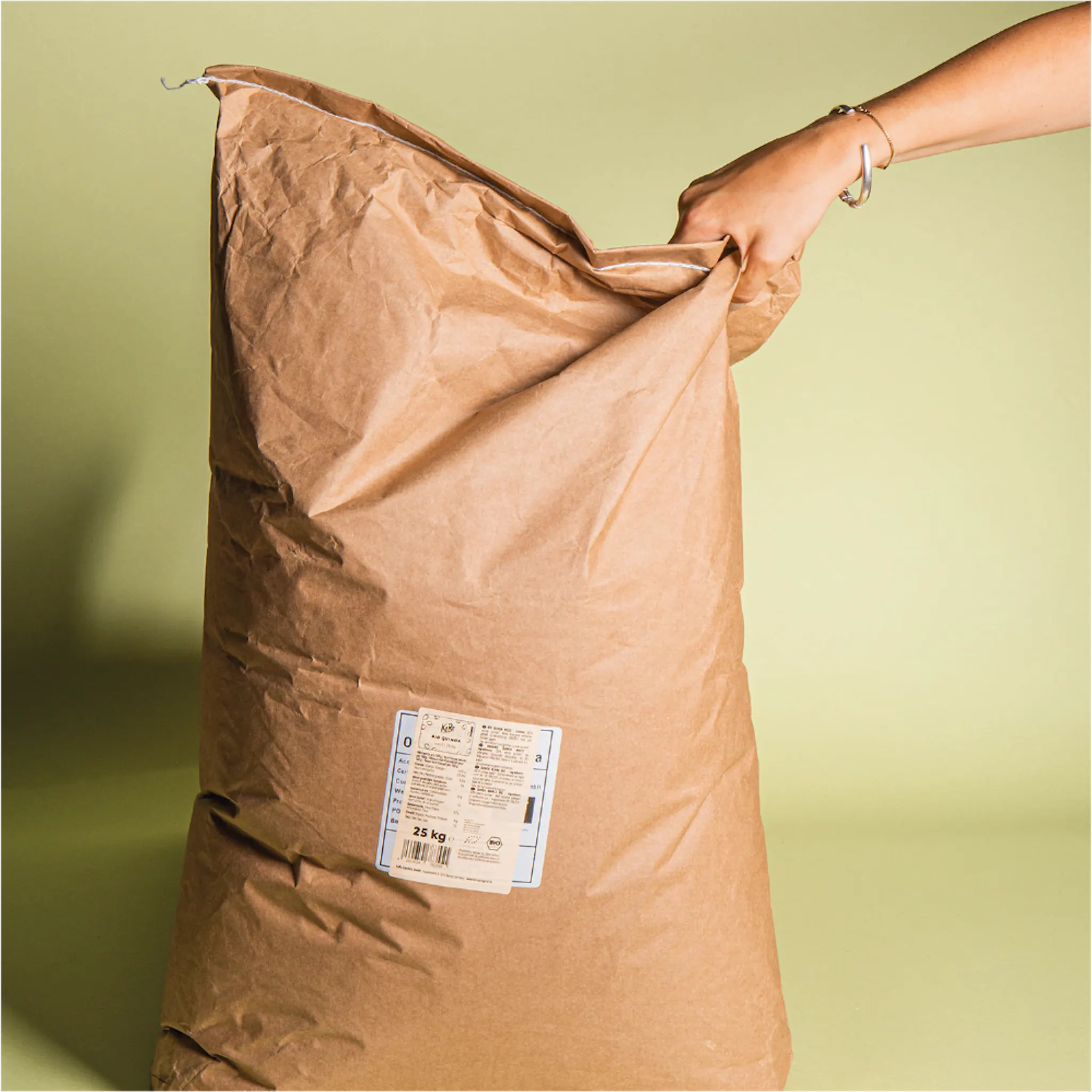
Our large packages are part of our identity. This not only makes commerce easier and keeps you happy for longer, but also reduces packaging waste by a lot compared to conventional packaging sizes.
Offer alternatives
We want to provide high-quality food at a fair price for your everyday life. We make sure that our products remain as natural as possible, contribute to a balanced, predominantly plant-based diet or that our snacks are a healthier and potentially more sustainable alternative.
Our key measures for more sustainability
First of all, it must be clear that sustainability has many facets and our definition includes economic, ecological, and social sustainability. Many measures are very long-term and therefore still in the initial phase. We therefore only want to list measures here whose positive effects we can already prove. Nevertheless, many more are planned, which we will of course report on in due course.
Our range
In general, with a 99% vegetarian and 89% vegan range and an organic product share of 54% (as of 04/2025), KoRo promotes an easy integration of potentially more environmentally friendly products. We also carry out thorough risk analyses for selected raw materials for our products and their countries of origin, based on the results of which, we develop a Sustainable Sourcing Policy that aims at reducing specific risks. In addition, we have implemented a code (Code of Conduct for Business Partners) that is aimed at suppliers and partners in general: this allows us to define our standards and expectations on environmental, corporate ethics, and social issues even more clearly than before.
Our office
We use green electricity from 100% renewable energy for our office and our website hosting provider is also powered by 100% renewable energy.
Our shipping packaging (boxes, filling material and parcel tape)
is already completely paper-based. A large proportion of the boxes and filling material is made from recycled fibers and can in turn be recycled. With our large packs, we save packaging waste – on average 40% per 1 kg of product – compared to conventional retail pack sizes.
With our large packs
we save packaging waste - on average 40% per 1 kg of product* - compared to conventional retail pack sizes.
Our sale category
We want to save food that is about to expire or does not meet the visual norm from being thrown away and therefore offer it to you in our sale category at a reduced price. Since 2023 we have also been donating to food sharing.
Our communication
Our most important measures are probably our transparent communication and our own sustainability team, who deals exclusively with the topics of the environment, corporate ethics, and social issues. We also want to share with you the progress, challenges and results that this team has achieved and encountered, in order to give you a deeper insight into the topic of sustainability. That is why we have set ourselves the goal, among others, of regularly publishing an impact report that provides insights into the topics of the environment, corporate ethics and social issues at KoRo. You can find the current report here.
Making climate impacts visible
In addition, we have already introduced the "Climate Impacts" tab for over 80 products (for example: White almond butter 500 g). For this purpose, we have calculated the greenhouse gas emissions that arise during the production, packaging and transport of our delicacies. We pass this information onto you so that you can make informed purchasing decisions and keep an eye on your own personal CO₂ footprint. But we also use these valuable findings: This way we can make our supply chains even smarter in the future and ideally also reduce our CO₂ footprint.
Current projects: What's on the agenda for 2025
We know that sustainability doesn't happen overnight – it requires long-term thinking and consistent action. That's why we set ourselves new goals every year that bring us closer to our aspirations, step by step. 2025 will be another year full of projects designed to bring about concrete change:
- Introduction of new monomaterial Doypacks which are easier to recycle
- Switching cocoa or coffee to Fairtrade quality on at least eight products
- Establishing a shorter supply chain for our cocoa powder and cocoa nibs by sourcing directly from producers at origin (will continue until 2026)
- Implementation of the EU Deforestation Regulation (EUDR)4 including improved traceability of our products affected by this regulation
- Updating the supply chain for ourr freeze-dried strawberry slices by sourcing some of the fruit directly from producers and conducting initial on-site visits in China (will continue until 2026)
- Preparation of our first sustainability report in accordance with established reporting standards and voluntary verification in accordance with the European VSME-Standard5 (finalisation and publication in 2026)
- Expansion of CO₂ footprint calculations on more than 150 products
- Conducting a company-wide ‘double materiality analysis’6 to assess both impacts and risks along the entire supply chain
- Drafting of a human rights policy statement and introduction of a complaints system7 for external stakeholders
>Q&A: Sustainability at KoRo
Suppliers and producers:

Packaging:

Products:
Other questions:
*As of 2022, calculation based on a sample of products from different categories - snacks, nuts, dried fruit, cooking ingredients - compared to competitors in the retail trade, extrapolated to our 519 bulk packs available in the shop
** https://www.bmel.de/EN/topics/farming/organic-farming/control-organic-farming.html
*** https://www.fairtrade.net/about/certification





.svg?cs=srgb&auto=format,compress&fit=fill&w=160)
.svg?cs=srgb&auto=format,compress&fit=fill&w=160)
.svg?cs=srgb&auto=format,compress&fit=fill&w=160)